
How to run an online raffle
A free-entry online raffle takes five things: a prize, a link, a close time, a draw nobody can question, and a record. Here is the whole process, starting with the part most guides skip.
Running a raffle online is mostly a solved problem. The part people get wrong is not the software. It is the entry fee.
Start with the entry fee, because it decides everything else
In most US states, a raffle where people pay to enter is a lottery. Lotteries are reserved for the state itself and, in some states, for licensed charitable organizations that filed a permit in advance. A business that runs a paid raffle is usually crossing that line whether it meant to or not.
The common shorthand for the test is three words: prize, chance, and consideration. You have a prize. You have chance, which is the entire point. Consideration is the one you control, and it means what an entrant has to give up to get in.
So the first decision is not which platform to use. It is this one: does entering cost anything?
If the answer is yes, stop here and talk to a lawyer licensed in your state before you sell a single ticket. If the answer is no, what you are running is a giveaway, and the rest of this is straightforward.
None of this is legal advice, state law varies, and it changes. If money is moving, get a lawyer.
The five things a free-entry raffle needs
1. A prize worth stopping for. The most common mistake is spending too much on it. The prize people remember is usually not the expensive one, it is the one they cannot buy. That is a whole subject of its own, and we wrote it up separately.
2. A way in that takes seconds. A link and a QR code, and nothing else. Every extra step costs you entries: an account to create, an app to download, an address typed twice, a form with a field nobody understands. If it takes longer than the walk past the poster, most people keep walking.
3. A close time everyone can see.Not “Friday.” A date and a time, printed where the entrant sees it before they enter. Ambiguity about when entries closed is the fastest way to an argument you cannot win.
4. A draw nobody can question. This is where homemade setups fall apart, and it is rarely about cheating. It is about the fact that you cannot prove you did not. A spreadsheet sorted by a random column is fine right up until someone asks whether you sorted it twice. A wheel you can spin again is a wheel you can spin again.
What you want is a draw that runs once, from a source of randomness that is not a formula anyone can predict, and that locks itself afterward so it cannot be quietly re-run. Then the result is the result, and there is nothing to argue about.
5. A record afterward. Who won, what they won, and when it was drawn. You will want this the first time somebody asks.
Draw it in front of people if you possibly can
Here is the thing nobody tells you: the draw being fair matters less than the draw being seen.
A winner announced by email is an administrative outcome. The same winner, drawn on a screen in a room, with the names moving and then slowing and then stopping, is an event. People stay for it. People film it. People enter the next one because they watched this one.
If you run the draw in front of the room, you also solve the fairness question without explaining it, because everyone watched it happen once.
geRaff does this on a screen with sound, and it is free on every plan, because charging for the best part of a raffle never made sense to us.
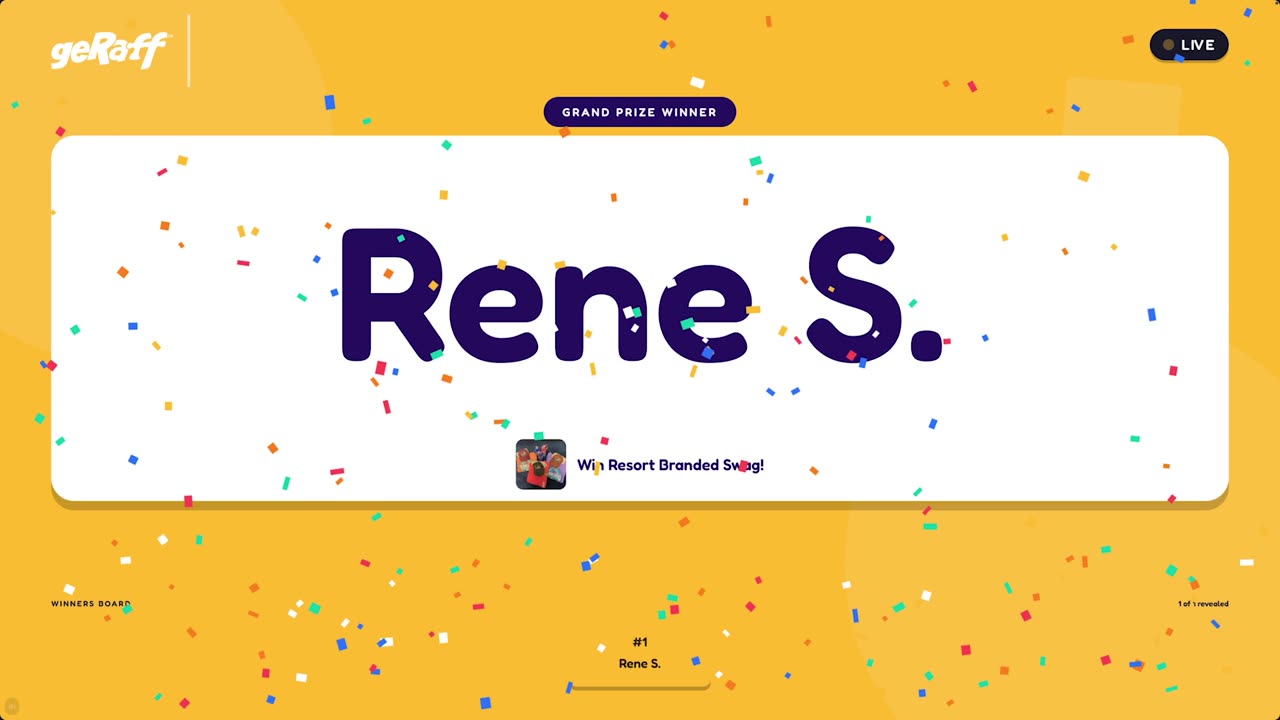
The live Showtime stage, recorded. The names are a test raffle.
If you already sold paper tickets
Plenty of people land here halfway through. The roll of colored tickets is already bought, half of it is already handed out, and the problem is just drawing the number.
That is a different job, and it does not need entries or a signup at all. You set the range from the first ticket on the roll to the last, and draw a number from it. geRaff has a tool for exactly that.
Two things to keep straight if you go that route. Whoever sold those tickets is responsible for whether that was legal where they are, and drawing a number is not the same as running a free-entry giveaway.
Four things to skip
- Do not collect more than you need. Every field you add is a field you are now responsible for storing, and most raffles need a name.
- Do not use a spinner you can re-spin. The problem is not honesty, it is that you cannot demonstrate it.
- Do not announce a prize you do not physically have.A prize you are “getting next week” becomes a prize you are explaining next week.
- Do not make entry conditional on a purchase.Not a drink, not a minimum spend, not a “with any purchase.” That is the entry fee again, wearing a hat.
The short version
- Entry is free. No exceptions and no clever workarounds.
- One prize people actually want.
- A link and a QR code, nothing more to enter.
- A close date and time, printed where entrants see it.
- A draw that runs once and cannot be re-run.
- Draw it in front of the room.
- Keep the record.
That is the whole thing. The software is the easy part.